
 HomeFlow
 Touch Stay
 Low6
Low6 Glasscubes
 Made (acq. by Next)
 PWN (acq. by PGi)
 Platinium Group
 Litera Microsystems
 Fortune 500 Firm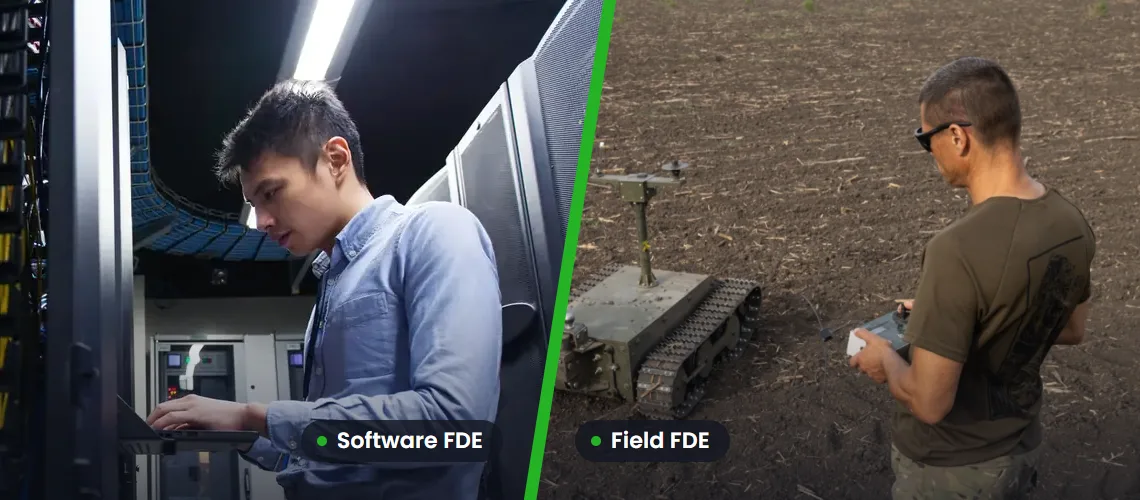
Two hiring briefs can arrive with the same job title and describe two different people.
One company needs someone in Ukraine who can diagnose a complex vehicle in the field, repair it, and explain the failure to an engineering team in another country. Another needs a developer who will sit with a customer, integrate an AI platform into their systems and keep it running in production.
Both advertise for a Forward Deployed Engineer, or FDE. Beyond the title, the two roles need different backgrounds, interviews and search channels.
Start by defining what this person must deliver. Then find out who can do that work under your real location, travel and employment conditions.
What a forward deployed engineer does
A forward deployed engineer works close to the people who use a product, makes it work in their environment and brings what they learn back to the product team.
Palantir popularised the title in software. It describes the job as owning stakeholder relationships and making architecture decisions alongside other engineers.
Its London vacancy for a Forward Deployed Software Engineer also asks for 25 to 50% travel, depending on team and location. Other employers set their own travel levels.
In physical engineering, the same job means installing equipment, diagnosing faults, repairing machinery and training operators. Employers advertise that work as field service engineer, commissioning engineer or technical service specialist.
Employers use “forward deployed” for civilian customer sites as well as military ones, so write the setting into the brief if it matters.
| Hiring question | Software FDE | Field FDE |
|---|---|---|
| What has to work? | A customer application, platform or integration | A vehicle, machine or robotic system |
| Core technical work | Coding, integration, deployment and production troubleshooting | Commissioning, diagnostics, maintenance and repair |
| Useful backgrounds | Software engineering, platform engineering, technical implementation | Vehicle diagnostics, mechatronics, industrial maintenance, field service |
| Customer contact | Understanding workflows and explaining technical trade-offs | Understanding operating problems and explaining equipment behaviour |
| Feedback to the product team | Reproducible bugs, integration gaps, customer requirements | Fault reports, service records, operating observations |
| What to ask candidates for | A working integration and a clear account of a production incident | A structured diagnostic approach and evidence of completed repairs |
The two versions overlap in robotics and embedded systems, where one person may read software logs in the morning and trace a wiring fault in the afternoon. Even there, decide which skill you need at expert level and which at a working level.
⚡️Scoping an FDE role in Ukraine? Send EchoGlobal the brief and we’ll flag the deal-breakers.
Evidence of demand in Ukraine
Grid Dynamics advertised a Forward Deployed Engineer (AI Platform) role in Kyiv, deploying and maintaining an AI orchestration platform across AWS, GCP, Azure, Kubernetes and on-premises environments.
The requirements read like a senior platform engineer’s CV: four or more years in Kotlin, Java, Go, Python or TypeScript, hands-on Docker, Kubernetes, Helm and Terraform, enterprise security and single sign-on, and practical work with LLM APIs.
It also asks for “willingness and ability to travel abroad for business trips.” Give that line its own screening step, apart from the technical interview. A strong developer can clear the interview and still be unable to travel.
The Fourth Law, a Ukrainian drone autonomy company, posted a Kyiv FDE vacancy on 31 August 2026. The company had closed it by the time we checked in late September.
That role meant troubleshooting in field conditions, regular trips to clients within Ukraine, technical reports after tests and real-time feedback to the development team. Candidates needed a background in software engineering, machine learning, embedded systems or IoT, plus electronics, single-board computers and hands-on drone experience.
It shows Ukrainian employers use the title.
On the hardware side, the UK Ministry of Defence revealed in March 2026 four operational maintenance, repair and overhaul facilities in Ukraine, with a fifth planned. UK companies run them under MOD contracts with British and Ukrainian staff, and British engineers work side by side with Ukrainian counterparts to service and repair military vehicles.
On Djinni, one of Ukraine’s main tech job boards, we found 11 vacancies titled Forward Deployed Engineer, and five were open on 1 October 2026.
Five centre on AI and LLM products, from logistics AI agents at Cargofy to a voice and chat platform for a travel-tech company. Three cover e-commerce platform integration and performance, and one is a general software role for US clients.
The other two are hardware roles in defence tech. A US-Ukrainian defence company wants an engineer to tune guidance, navigation and control for multirotor and fixed-wing drones. A European autonomy startup wants someone to deploy its software on drones alongside Ukrainian partners and report field-test findings back to its developers.
From these examples you can confirm demand for software deployment and for hands-on equipment support. You can’t size the national vacancy count or a ready-to-hire talent pool from them.
Can the role be filled?
Yes. The speed depends on details you won’t find in the job title.
For a software FDE, define the coding depth, the customer responsibility and the deployment environment. A developer who does excellent work from well-defined tickets may need time and support before owning an ambiguous customer implementation.
For a vehicle or robotics FDE, separate the diagnostic skills that must exist on day one from the product knowledge you can teach. An experienced agricultural machinery technician may bring the electrical and mechanical fault-finding you need without having touched a robot.
Some positions need an engineering degree. For service-heavy roles, vocational training plus years of repair work can be the stronger evidence, so set the qualification from the responsibilities.
A narrow technical specialism, strong English, independent field work, frequent international travel and a tight budget are each reasonable requirements. Combine all five and you may be left with a handful of people.
Agree these details before you start the search:
- The work location, travel frequency and operating conditions within Ukraine.
- The working-hours overlap with your customers. Three of the Djinni vacancies required regular overlap with US Eastern Time.
- The balance between repairs, software work, operator support and reporting.
- The overseas training schedule, and whether further trips are essential.
- The employment arrangement, pay range and expense coverage.
- The equipment, spare parts and remote technical support available.
- Which decisions the engineer can make alone, and how escalation works.
For field work in a country at war, spell these conditions out for each candidate before they accept an offer.
How big the real pool is
You won’t find a defensible national number for the skill mix a typical FDE brief describes.
Lviv IT Cluster’s IT Research Ukraine 2025 counts 303,000 Ukrainian tech professionals, 245,000 of them living and working in Ukraine. That figure covers the whole tech workforce.
Lviv IT Cluster doesn’t split it by FDE experience or travel eligibility, and because it surveys the IT industry, its count excludes most vehicle maintenance specialists.
For recruitment purposes, split candidates into three groups:
- People whose experience might transfer.
- People who meet the role’s technical, communication and location requirements.
- People who also meet the travel conditions, want this job and accept its package.
Your immediate hiring pool is the third group. Build the market map around it: record how many people you identified, contacted, screened and assessed, and why each one dropped out, whether English, a technical gap, pay or travel.
Treat 100 plausible profiles as a starting point and one failed outreach batch as one data point. Report what you observed, and keep small samples out of national estimates.
Backgrounds to target
Treat these routes as sourcing ideas, listed in no particular order.
| Background | Potential fit | What to check |
|---|---|---|
| Backend or full-stack engineering | Customer applications, APIs and integrations | Direct customer ownership and deployment experience |
| Platform engineering, DevOps or SRE | Infrastructure-heavy implementations | Coding depth and a grasp of user workflows |
| Solutions or implementation engineering | Requirements discovery and customer delivery | Whether they still build and troubleshoot systems themselves |
| Embedded systems and mechatronics | Products that combine software and hardware | Depth of hands-on repair and field experience |
| Automotive diagnostics and vehicle electrics | Vehicle fault-finding and electrical troubleshooting | Experience beyond routine servicing, plus working English |
| Agricultural or construction machinery service | Mobile repairs on mixed mechanical and electrical systems | Transferability to your product and its diagnostic tools |
| Industrial maintenance and commissioning | Equipment installation and systematic troubleshooting | Mobility, customer communication, relevant system knowledge |
| Military equipment maintenance or veteran technical experience | Practical equipment support in operational conditions | Individual skills, civilian availability and travel eligibility |
Search beyond the title “Forward Deployed Engineer”, because most people who could do this job have held other titles.
For field roles, search Ukrainian job sites for the local equivalents of service engineer, repair engineer, electromechanical engineer, auto electrician and diagnostician, and commissioning expert. Then check each profile for the relevant equipment and customer-facing work.
Travel: the biggest filter
If the role needs travel abroad, expect that one condition to decide the search. You’ll know how many people it rules out after you screen real candidates.
Across the Djinni vacancies, travel ranged from fully remote roles for US clients to about 15 to 20% travel to the United States for an AI platform role. Both hardware roles required candidates based in Ukraine, and eight of the nine software roles accepted candidates elsewhere in Europe or worldwide.
Answer three questions for each candidate: does the law let them leave Ukraine for this trip, can they enter the destination country for this activity, and will they go?
Under martial law, most Ukrainian men of military age need a qualifying exemption to leave the country, so you have to check eligibility person by person. Since 26 August 2025, men aged 18 to 22 inclusive may cross the border, with limited exclusions.
A 21-year-old who can travel may still lack the experience a senior role needs. Don’t infer eligibility from a CV, veteran status or an employer’s general statement about mobilisation. A recruiter screens for lawful travel eligibility and has no power to grant it.
Raise the travel requirement in the first conversation. Route document checks through a proper HR or legal process, and recheck the rules before each trip, since the rules and a person’s circumstances can change between trips.
Separate a single training visit from recurring international travel. If overseas training is the only obstacle, check whether your team could run the training in Ukraine or onboard the engineer another way.
If you allow remote work, a software FDE can handle much of the customer work from anywhere, which widens the search. Field repairs still need an engineer on site.
Why English matters
A field engineer can diagnose a fault and still send the product team too little information to reproduce it. A software engineer can build a sound solution to the wrong problem because they misread what the customer needed.
Test English with realistic tasks: ask a software candidate to explain a deployment incident to a customer, and a field candidate to describe an unfamiliar equipment fault to a remote colleague.
Then ask for a short written report covering symptoms, checks completed, evidence collected and open questions. Pass it if another engineer could act on it without calling back. Judge clarity and accuracy, and ignore the accent and small grammar slips.
Search and assessment
Start with a short scoping call to agree which requirements are essential on day one and which your team can teach.
For software candidates, use professional networks, developer communities and the main Ukrainian tech job boards, such as DOU and Djinni. Search for implementation ownership and production responsibility alongside the stack.
For field candidates, go wider: equipment distributors, service companies, maintenance teams and technical referrals. Post on general job sites like Work.ua and robota.ua too, where experienced technicians look for work, including strong ones without a degree.
Build the assessment around the job. For software, set a small integration task, a failing deployment or a requirements conversation with a mock customer.
Several FDE vacancies in Ukraine list AI coding tools such as Claude Code, Cursor, GitHub Copilot or Replit among the required skills. If your team builds that way, let candidates use the same tools in the exercise and judge the result.
For field work, use a safe training rig, a real service history or a simulated fault, and watch how the candidate reasons, documents findings and decides to escalate.
Test product feedback with one question: “What would you send the engineering team so they could investigate this without being there?”
Ask for a shortlist that covers each candidate’s technical fit, English assessment, location, pay expectations, remaining gaps and travel status, with anything unverified marked as such.
Timelines, fees and agencies
Treat the timings below as our planning estimates for an FDE search, with no delivery guarantee.
| Stage | Planning allowance |
|---|---|
| Agree the brief and assessment criteria | 2 to 5 working days |
| Map the market and test candidate interest | 1 to 2 weeks |
| First assessed software FDE profiles | About 2 to 4 weeks from an agreed brief |
| First assessed field or robotics profiles, with strong English and overseas travel | About 3 to 6 weeks, possibly longer |
They assume you’ve approved a pay range, lined up interviewers and can give prompt feedback. Some stages overlap, and a scarce skill combination, a difficult location or a travel constraint can add weeks.
Review the estimate after the first outreach cycle. If most candidates who pass the technical bar fail on the same condition, discuss that condition with your recruiter before you continue.
Plan the start date apart from the shortlist date: final interviews, notice periods, the employment setup and training all come after the shortlist.
We haven’t found a verified, Ukraine-specific fee benchmark for FDE searches, so expect each agency to propose a fee for the assignment you agree. Agencies offer a success fee payable on hire, a staged retained search, or a paid market-mapping phase credited against a later placement fee.
If the brief is uncertain, start with a defined mapping phase to test your assumptions before you commit to a full search.
Put the fee basis, payment trigger and any minimum charge in the agreement, along with exclusivity, replacement conditions, candidate ownership and what happens if you change the brief midway.
Keep recruitment fees and employment costs in separate budgets. For field roles, the package has to cover travel time, accommodation, equipment, insurance suited to the work and any on-call arrangements.
Benchmark pay against the work itself. You won’t find travelling vehicle specialists in generic software salary surveys, and a role with international communication and product feedback built in should pay above a standard mechanic’s salary.
Ask any agency you evaluate for comparable placements and a description of its assessment process. Compare the work behind each placement: field repairs, customer deployments, vehicle diagnostics, electronics, software integration.
An agency that has placed software engineers with a defence manufacturer knows the sector. Assessing a vehicle technician’s diagnostic skills takes separate experience.
Expect a good agency to tell you where its experience applies and where it will bring in extra technical assessment support. To compare options, see our overview of IT recruitment experts in Ukraine.
To hire an FDE in Ukraine, write a precise account of the work, search the adjacent professions, test for practical ownership and check travel and employment conditions in the first conversation.
Hiring an FDE in Ukraine with EchoGlobal
EchoGlobal has recruited tech specialists in Ukraine since 2013, and we can run your FDE search the way this guide sets out. In the first call we agree the work, travel and English requirements with you. Then we search the adjacent professions as well as engineers with the FDE title.
We start with our CV database: 34,700+ profiles, more than 9,000 of them in Ukraine.
We vet software and AI candidates ourselves. For hardware or vehicle diagnostics, we agree the practical task with your engineers and bring them into the assessment.
If you have no legal entity in Ukraine, we can employ the engineer and handle payroll, compliance, HR and benefits. You get a three-month trial period with one day’s notice, and you can part ways at no cost in the first week.
Sources
- Palantir: Forward Deployed Software Engineer, London. Vacancy reviewed September 2026.
- Grid Dynamics: Forward Deployed Engineer (AI Platform), Kyiv. Vacancy reviewed September 2026.
- The Fourth Law: Forward Deployed Engineer, Special Operations, Kyiv. Posted 31 August 2026.
- UK Ministry of Defence: UK reveals military maintenance facilities in Ukraine for first time. 7 March 2026.
- Lviv IT Cluster: IT Research Ukraine 2025 results. 11 December 2025.
- UNN: men aged up to and including 22 may cross the border. 26 August 2025.
- Djinni: vacancies titled Forward Deployed Engineer. 11 found, reviewed 1 October 2026.